

Latino Homeownership in Los Angeles: Stories, Struggles, and Progress
- 4 May 2026
- Munif Ali

Designed by Freepik
In Los Angeles, the Latino community is one of the strongest, fastest-growing buyer groups in the country, yet the path to homeownership still feels tighter than it should be.
Latinos added 441,000 new homeowners in 2025 alone, the largest annual increase on record (NAHREP, 2025). But momentum doesn’t always mean the doors are wide open. It just means people are pushing harder to get through them.
The Demand is There, But the System is Lagging.
Latino homeownership in Los Angeles is caught in a contradiction. Demand is strong, driven by population growth, rising incomes, and long-term cultural emphasis on owning property. However, affordability has outpaced real estate access, and the gap between the two continues to widen.
Homeownership in the United States has always been one of the primary engines of wealth creation. Homeowners accumulate more net worth over time than renters due to equity growth and asset appreciation (Joint Center for Housing Studies of Harvard University, 2023). But access to that engine has never been evenly distributed.
First-time Latino homebuyers have historically entered homeownership later in life, with lower initial equity and fewer generational transfers of property compared to other demographic groups. That delay compounds over time. Every year without ownership is a year without appreciation, leverage, or refinancing power.
Homeownership Challenges for Latino Communities
Homeownership challenges are not hidden. They are layered into everyday financial decisions, family responsibilities, and the way the lending system interprets the profiles of first-time Latino homebuyers.
1. Income vs Housing Prices
Wages have not kept pace with home values in Los Angeles. Many Hispanic homebuyers in Los Angeles rely on multi-income structures that don’t always look “clean” on paper. Gig work, cash-heavy jobs, overtime, and family-supported households are common. Even when total household income is strong, it is often fragmented across multiple earners, which can complicate loan qualification in conventional systems (HUD, 2024).
2. Lending Friction and Credit Sensitivity
A significant number of Latino first-time buyers are either new to credit systems or have limited traditional credit history. This doesn’t immediately equate to financial irresponsibility, but it often reflects delayed or simply different engagement with credit-building tools.
In underwriting, thin credit files often lead to stricter conditions, greater scrutiny, or additional documentation requirements before approval.
3. Down Payment Accumulation
In Los Angeles, even modest homes require down payments that can take years to accumulate. For many first-time Latino homebuyers, that timeline is further extended by the rent burden and obligations to family for financial support.
4. Immigration and Documentation
For some Latino households, especially mixed-status families, the mortgage process can involve additional caution around documentation, identification, and long-term financial planning. Even when eligibility exists, uncertainty around documentation requirements can delay participation in the homebuying process (Pew Research Center, 2024).
5. Geographic Compression
Many Hispanic homebuyers in Los Angeles are being pushed out of historically accessible neighborhoods. These regional displacement patterns have been consistently linked to housing cost escalation and redevelopment cycles (UCLA Latino Policy & Politics Institute, 2024). What that’s led to is straightforward but heavy: families getting priced out of neighborhoods they’ve lived in for years, longer commutes just to stay employed, and entire communities slowly losing their cultural identity.
These are not isolated issues. They intersect. And together, they define Latino homeownership challenges in Los Angeles more accurately than any single statistic ever could.
The System Behind the Ownership Gap
There’s a habit of framing Latino homeownership in Los Angeles like it’s some race to catch up. That’s the wrong lens. It doesn’t just miss the point—it shrinks the story.
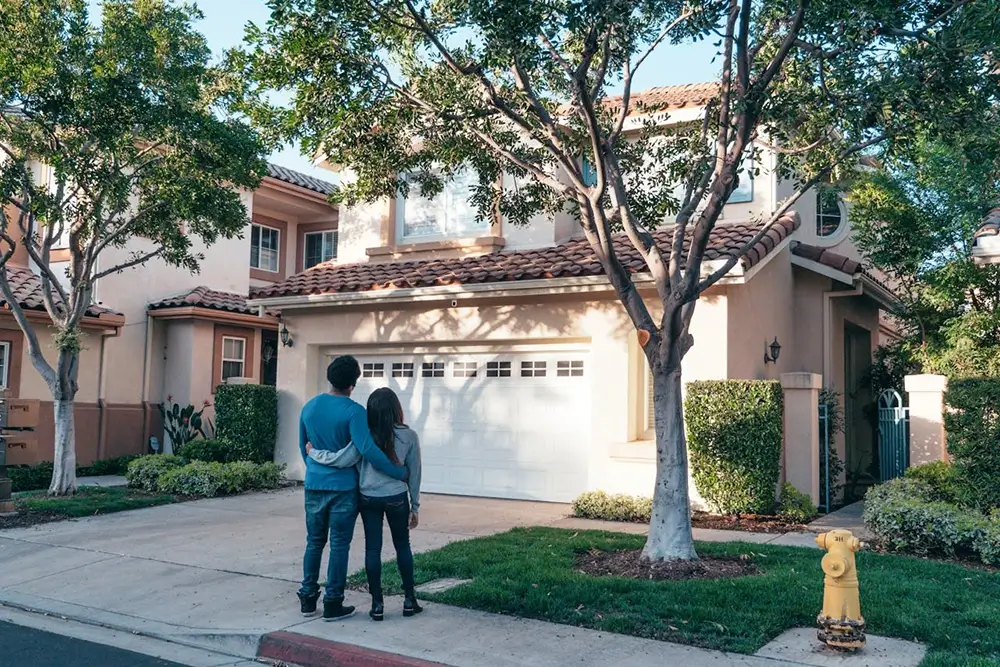
From Kindel Media on Pexels
For many Latino households, entry into the housing market has historically come later, often after years of renting, supporting extended family, or stabilizing income streams. By the time first-time Latino homebuyers are financially ready, the market has already moved. Prices are higher. Competition is tighter. Lending requirements are less forgiving.
The gap didn’t appear overnight—it was built through years of structural homeownership challenges, including uneven access to financing, limited entry into appreciating neighborhoods, and delayed exposure to real estate as a wealth-building tool.
Even when income and employment are strong, access doesn’t automatically level out. Latino borrowers are still more likely to be placed in higher-cost mortgage products and subjected to stricter lending scrutiny than similarly qualified applicants. That difference quietly reduces purchasing power at the exact moment it matters most, shaping what families can realistically afford and where they can compete in the market (UCLA Latino Policy & Politics Institute, 2024).
So the issue isn’t just qualification. It’s positioning.
In Los Angeles, access is tightening faster than supply is expanding. That pressure impacts all buyers, but it hits first-time and working-class buyers first. The Latino community is directly inside that pressure zone. And yet, even within that system, movement is happening. Not because the system became easier, but because buyers became more strategic in their approach to it.
How Latino Buyers are Achieving Homeownership Despite Barriers
Across the U.S., Hispanic homebuyers in Los Angeles have been driving homeownership growth more than any other group over the past decade, accounting for over one-third of total net gains despite representing a smaller share of overall households (National Association of Realtors, 2024). Los Angeles has always been shaped by its Latino community—through work, culture, and long-term presence. Homeownership is simply the next layer of that story.
1. Multi-Income Qualification
One of the most consistent patterns is income pooling. Instead of relying on a single income, many Latino buyers are structuring purchases around combined household earnings. Co-borrowing becomes a primary strategy. Families combine earnings across multiple adults in a household to meet qualification thresholds that would otherwise be out of reach individually (NAHREP, 2024).
2. Geographic Strategy
Affordability has forced many Hispanic homebuyers in Los Angeles and across the country to expand their search beyond traditional neighborhoods. Buyers are weighing commute time, price, appreciation potential, and long-term positioning rather than locking into legacy locations. The idea is simple: get in where it’s still possible, then build from there.
3. Alternative Financing
Non-traditional loans and programs designed for self-employed borrowers are becoming more common entry points for Latinos. These options allow buyers with non-W-2 income, business revenue, or unconventional financial profiles to qualify when traditional underwriting might otherwise block them (Nclusive Financial Corp., 2026).
This matters because a large portion of Latino households are represented in entrepreneurship, contract work, and small-business ownership. Standard lending models don’t always reflect that income structure.
So buyers are finding lenders and programs that do.
4. Community Knowledge Networks
Real estate access often moves through trusted networks. Family referrals, cultural familiarity with agents, and community-based guidance systems play a major role in decision-making.
Even in what has been described as one of the least affordable housing environments on record, Latino homebuyers have continued to increase ownership numbers by adjusting how they buy, where they buy, and who they buy with (NAHREP, 2024).
And at Pacific Playa Realty, we understand that dilemma clearly. In solidarity with the Latino community, we honor Cinco de Mayo by reaffirming our commitment to support families working toward homeownership and long-term wealth through real estate.
In Los Angeles, progress is happening one purchase at a time, and every step forward is proof that the barrier is real, but so is the will to overcome it.
The State of Latino Homeownership in Los Angeles Today
The direction is clear, even if the path is uneven. Latino homeownership in Los Angeles continues to grow, but the gap between demand and supply remains wide.
Younger Latino households are entering the market earlier than previous generations, often through more aggressive financial planning and multi-income strategies. At the same time, affordability constraints continue to slow the pace of entry. Conversations about this cannot be reduced to “growth story” language. We’re talking about progress and pressure happening at the same time.
And that tension defines this market.
So the real takeaway isn’t that Latino homeownership in Los Angeles is difficult. That part is already known. The real story is that despite the difficulty, it is still moving forward. Quietly. Consistently. And in ways that will compound over time.
Because in a city where access is selective, persistence becomes its own form of equity.
Pacific Playa Realty is here not to romanticize the barriers or pretend they don’t exist. We’re here to break them down with you, step by step, with clarity, guidance, and real support that meets people where they are. We believe homeownership shouldn’t feel like a closed door with a long list of requirements just to knock. It should feel navigable. Possible. Within reach.
FAQs
Renovations are helpful, but going overboard can backfire. Over-renovating may make your home feel customized to your taste rather than appealing to a wide pool of buyers.
Yes. Too many personal or high-end improvements can alienate buyers and delay a sale. Smart updates should enhance, not overpower, the home’s appeal.
Focus on updates that improve functionality and appeal, such as fresh paint, updated kitchens or bathrooms, and landscaping. These pre-sale upgrades often deliver the strongest renovation ROI.
Repairs that fix visible or functional issues should come first. Cosmetic updates can follow, but only if they add clear value to buyers.
If the cost of the upgrade exceeds the expected increase in the sale price, it’s likely not worth it.
Yes. Strategic staging can make a home feel modern and inviting without major investment, sometimes offering a higher return than expensive upgrades.
Understanding what local buyers value helps you prioritize. Updates that align with popular preferences and expectations are more likely to pay off than personal or unusual choices.
Your dream home starts with the right partner. Pacific Playa Realty can help you enter homeownership much faster and more smoothly.
Key Takeaways
- Real estate access remains the central issue, shaping who can enter the market, when they can enter, and under what financial conditions.
- The gap in Latino homeownership in Los Angeles is not driven by a lack of intent but by structural barriers, such as down payment requirements, lending friction, and long-term housing price escalation.
- Hispanic homebuyers in Los Angeles are adapting through strategies such as shared household income, geographic expansion, and long-term ownership planning rather than short-term purchasing.
- How homeownership builds wealth for Latino families is tied to equity accumulation, which remains one of the most powerful tools for generational financial stability in the U.S.
References:
Ali, M. (2026, March 3). Breaking Barriers: How Alternative Documentation Loans Help Self-Employed Borrowers Qualify. NCLUSIVE FINANCIAL CORP. https://nclusivefinancialcorp.com/how-alternative-documentation-loans-help/
National Association of Hispanic Real Estate Professionals. (2024). State of Hispanic homeownership report 2023. https://nahrep.org/press-releases/2024/03/12/nahrep-report-hispanics-approach-50-percent-homeownership/
National Association of Realtors. (2024). Snapshot of race and home buying in America. National Association of REALTORS®. https://www.nar.realtor/newsroom/in-the-news/whats-behind-the-spike-in-homeownership-rates-among-asian-americans-hispanics-usa-today
Pew Research Center. (2024). Hispanic Americans and their experiences in the U.S. financial system. https://www.pewresearch.org/hispanic/
UCLA Latino Policy & Politics Institute. (2024). Housing access, displacement, and Latino communities in California. https://latino.ucla.edu/research/housing-access-displacement/
U.S. Department of Housing and Urban Development. (2024). Housing affordability and mortgage underwriting guidelines. https://www.hud.gov/program_offices/housing